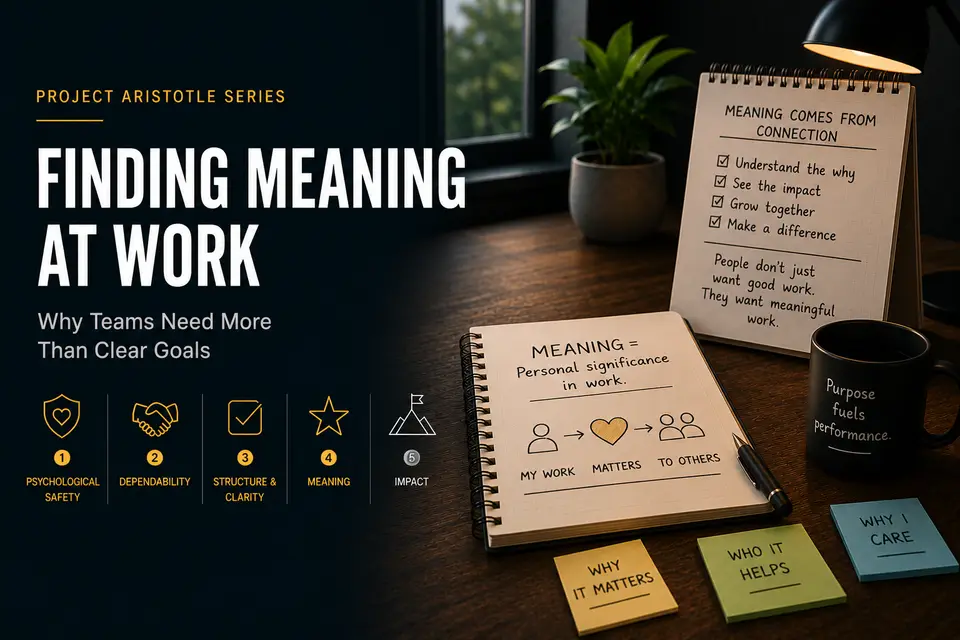
Finding Meaning at Work - Why Teams Need More Than Clear Goals

When Google researched what makes teams effective in Project Aristotle, they discovered something surprising.
The best teams were not simply the smartest. They were not built from the highest-performing individuals. And they were not the teams with the strictest processes.
Instead, high-performing teams consistently shared five characteristics: psychological safety, dependability, structure and clarity, meaning, and impact.
In previous articles from this series, I explored:
- What Really Makes a Team Effective? A Lesson from Project Aristotle
- From Psychological Safety to Dependability: How Teams Learn to Deliver
- Structure and Clarity: Why Even Strong Teams Fail Without Clear Direction
The first three elements are relatively straightforward to understand.
People need to feel safe speaking up. They need to trust each other to deliver. And they need clarity around goals and responsibilities.
But then comes a more subtle question:
Does the work actually mean something to the people doing it?
This is where many teams quietly start to break down.
The Hidden Problem of "Functioning" Teams
Some teams look healthy from the outside.
They hit deadlines. They attend meetings. They follow processes. They ship features.
Yet the energy is gone.
Conversations become transactional. Initiative disappears. People stop challenging weak ideas. Work turns into a sequence of tickets instead of a shared mission.
Nothing is obviously broken. But nothing feels alive either.
This is often what happens when teams lose a sense of meaning.
Project Aristotle defined meaning as: finding personal significance in work.
And that definition matters.
Meaning is not about motivational posters or company slogans. It is about whether people can connect their daily work to something personally valuable.
Because humans rarely sustain excellence for long when their work feels emotionally disconnected from purpose.
Why Meaning Matters More Than We Think
In engineering organizations especially, we often assume motivation comes from compensation, technology, or ambitious roadmaps.
But experienced teams know something else is true.
People give their best effort when they understand:
- why the work matters,
- who it helps,
- and why they personally care about contributing to it.
Without that connection, even strong teams slowly drift toward minimal engagement.
You can see it in small behaviors:
- fewer ideas,
- less ownership,
- lower curiosity,
- quieter retrospectives,
- more "just tell me what to do."
And ironically, this often happens after teams improve operational maturity.
Once chaos is removed, people begin asking a deeper question: "What are we actually trying to achieve?"
Clear process is necessary. But process alone does not inspire commitment.
Meaning Is Personal, Not Universal
One important lesson from Project Aristotle is that meaning is deeply individual.
Different people find motivation in different things.
For some engineers, meaning comes from solving difficult technical problems. For others, it comes from customer impact. Others care most about learning, autonomy, craftsmanship, or helping teammates succeed.
Managers often fail here because they try to create one generic source of motivation for everyone.
But meaning cannot be standardized.
The same project can energize one person and completely drain another.
That is why effective leaders spend less time trying to "motivate the team" and more time understanding what motivates individual people.
The Mistake Leaders Often Make
Many organizations unintentionally disconnect teams from meaning.
They overload teams with:
- delivery pressure,
- constant reprioritization,
- fragmented ownership,
- and endless execution cycles.
As a result, people stop seeing outcomes. They only see tasks.
Engineers become feature factories. Designers become ticket processors. Managers become roadmap administrators.
And eventually, nobody feels connected to the real impact of their work.
Ironically, this usually happens in companies obsessed with performance.
But sustainable performance requires emotional investment. And emotional investment requires meaning.
You cannot expect deep ownership from people who feel detached from the purpose behind the work.
Meaning Changes Team Dynamics
Teams with strong meaning behave differently.
They show more resilience during difficult periods. They recover faster from failures. They tolerate ambiguity better. And they maintain higher engagement even under pressure.
Why?
Because meaningful work creates intrinsic motivation.
People are no longer contributing only because they are assigned tasks. They contribute because they believe the work matters.
That changes everything.
Suddenly:
- feedback feels useful instead of threatening,
- accountability feels shared instead of imposed,
- and collaboration becomes more natural.
Meaning does not replace psychological safety or structure. It amplifies them.
Creating Meaning Is Not About Inspiration Speeches
Leaders sometimes think creating meaning requires charisma.
Usually it does not.
In practice, meaning often comes from much simpler things:
- showing customer outcomes,
- explaining business context,
- connecting work to real users,
- celebrating progress,
- giving ownership,
- and helping people see growth in themselves.
Small moments matter.
A developer hearing how a feature helped customers. A designer seeing usage data after release. A team understanding why priorities changed instead of simply receiving orders.
Meaning grows when people feel connected to consequences.
Not just responsibilities.
The Strongest Teams Understand Why Their Work Exists
Project Aristotle showed that effective teams are not built only on execution mechanics.
They are built on human dynamics.
And meaning is one of the most important of them.
Because eventually every team reaches the same point:
Clear goals are no longer enough. Reliable delivery is no longer enough. Even psychological safety is no longer enough.
People also need to believe their work matters.
Not abstractly. Not at the company-all-hands level.
Personally.
And the teams that sustain high performance over time are usually the ones where people can answer a very simple question:
"Why does this work deserve my best effort?"
Sources
- Google re:Work - Understanding Team Effectiveness (Project Aristotle)
- Leading Effective Engineering Teams - Addy Osmani
- Team Topologies - Matthew Skelton, Manuel Pais
Comments